Flourish

We must always be a welcoming city

By

Pope Leo and Archbishop Nolan have spoken out for integration and solidarity as the Church prepares to mark World Day of Migrants and Refugees this month.

Read more…

Kelvingrove

New home for Dalí’s Christ

A Glasgow painting which the Vatican asked to be lent to Rome for the recent Holy Year, has been given a new home at the Kelvingrove Art Gallery.
Read more…

film

Matt Talbot comes to the big screen

An inspirational movie made by an Emmy-winning director telling the extraordinary story of Venerable Matt Talbot will have its Scottish premiere in Glasgow next month.
Read more…

st francis

‘More than a pipe band’… 100 years of marching in the footsteps of St Francis

During the dark days of the General Strike of 1926 the 12 Franciscan priests based at the Gorbals church on Abercrombie Street named after their patron, had a problem…
Read more…

September issue

Read now
Download the September 2026 issue of Flourish (PDF, 9 MB)

Recent issues

We must always be a welcoming city

By

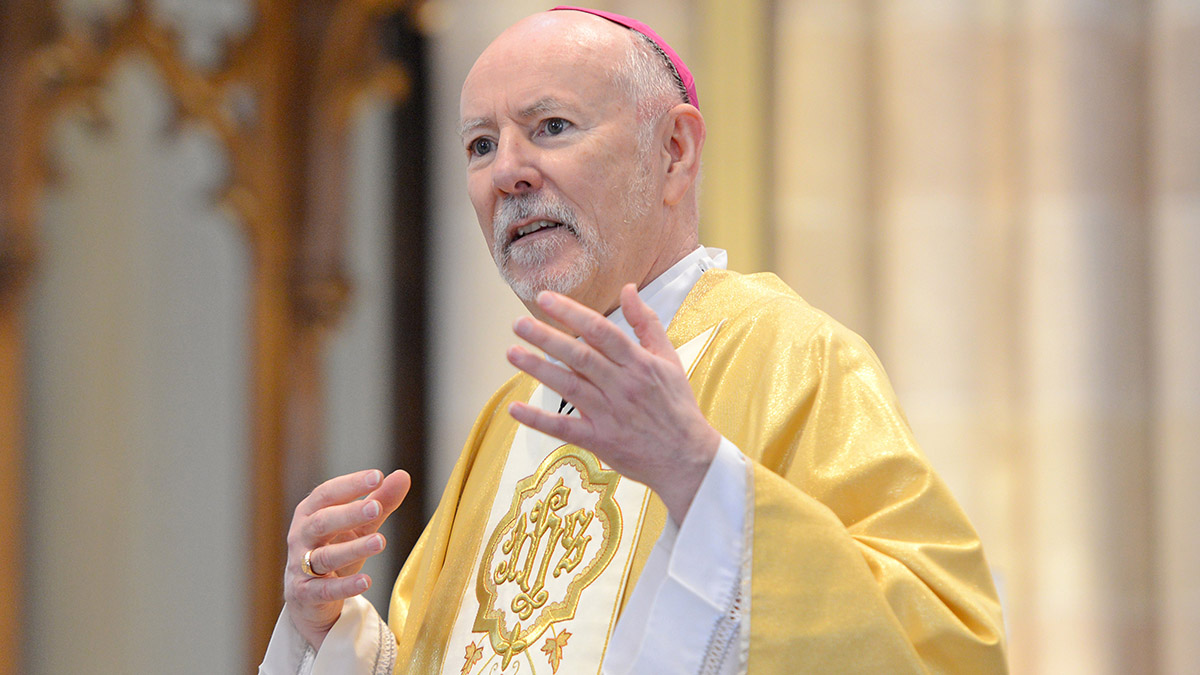
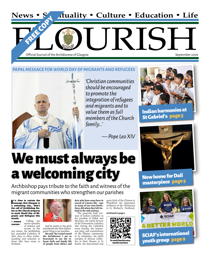
It’s time to restate the message that Glasgow is a welcoming city… that’s the call of Archbishop Nolan as the Church prepares to mark World Day of Migrants and Refugees this month.

Image illustrating this story
Archbishop Nolan

Calling out recent episodes of violence and racism in the city centre, the Archbishop has reminded Catholics of their duty to show understanding and welcome to those who have come to Scotland.

And he points to the great enrichment the ‘New Glaswegians’ bring to our parishes.

He said: “As I travel round the Archdiocese I am so heartened to see the vibrant faith and family life of people from Africa and Asia who have come here in search of a better life – just as many of our own forefathers did when they left Ireland in the 19th century.

“The powerful faith witness of Indian Catholics in the parishes of Pollok and Merrylee, the joyful fervour of the Vietnamese Catholics who throng the Cathedral every Sunday, the impressive piety and commitment of the Filipino community in St Columba’s, the joyful worship of African Catholics in their Masses at St Roch’s, the determined and quiet faith of the Chinese in Wyndford, the impressive resilience of the Ukrainians in St Michael’s, Parkhead, the reverence and rock solid faith of the Poles in Dennistoun…

“I visit Catholic schools where literally dozens of languages are spoken. It is a powerful witness of the universality of the Church and the welcoming atmosphere in our Catholic schools.

“Far from denouncing immigrants we should accompany them in their integration and be grateful to them for their witness and the injection of life and faith they provide in our parishes.”

The Archbishop said: “Clearly mass migration has brought serious challenges, and an ordered but compassionate immigration system is needed. Glasgow has played its part in welcoming asylum seekers and that has brought certain tensions which need to be addressed by the relevant authorities.

“But as Catholics we would do well to listen to the Pope’s message for this month which calls in no uncertain terms for us to welcome migrants – especially children and young people in need.”

In that Message for the 2026 World Day of Migrants and Refugees, which is marked later this month, the Holy Father writes: “Christian communities should be encouraged to promote the integration of refugees and migrants and to value them as full members of the Church family, fostering new educational and spiritual paths, including personalized ones, which go beyond the mentality of mere assistance.

“In particular, it is essential to prevent the solitude, isolation and rejection that not infrequently also affect the children of migrants; and to promote opportunities for encounter and integration in which local young people and young migrants can support each other along a path of mutual respect and friendship.”

Share

New home for Dalí’s Christ

By

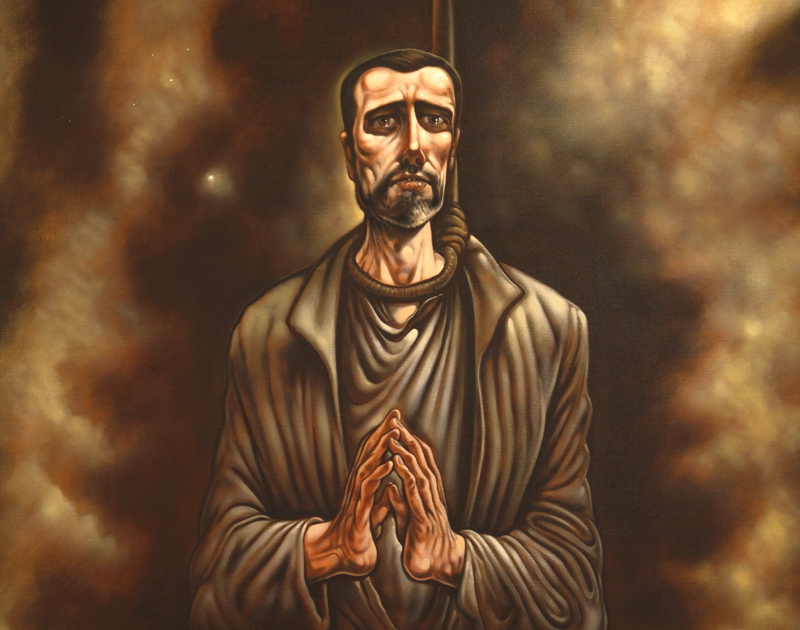
A Glasgow painting which the Vatican asked to be lent to Rome for the recent Holy Year, has been given a new home at the Kelvingrove Art Gallery.

Image illustrating this story
Christ of St John of the Cross was bought in 1952 for £8,200

Glasgow Life has repositioned the Christ of St John of the Cross by Salvador Dalí, in a larger, purpose-built space on the ground floor of the museum, offering visitors an uninterrupted view and the opportunity to spend more time experiencing it.

The new display allows two ways of experiencing the painting: a quiet contemplative space for reflection and prayer and an enhanced digital display, which reveals insights into Dalí’s art and the story of how it was acquired for Glasgow’s collection.

Chair of Glasgow Life, Bailie Annette Christie, said: “It’s difficult to quantify the incredible impact of Dr TJ Honeyman’s visionary acquisition for Glasgow and the cherished role it plays in the spiritual and cultural lives of Glaswegians and visitors to the city.”

Director of Glasgow Art Galleries Dr TJ Honeyman spearheaded the purchase of the painting by the city in 1952 for £8,200, despite criticism from some who considered it ‘too Catholic’.

She said the new digital display “explores Dalí’s spiritual inspiration and allows visitors to learn more about one of the city’s most important cultural assets.

Iconic

“We are certain the iconic Christ of St John of the Cross will remain a highlight of any visit to Kelvingrove for generations to come.”

Digital screens will transport visitors to Port Lligat, in Figueres, Spain where it was created 75 years ago. The presentation uses Dali’s own words to explain how the painting was made and recounts how the vision for the work came to him in two ‘cosmic’ dreams.

Visitors can also access a new digital guide on their smartphone. Salvador Dalí – Stories Behind a Masterpiece – features audio that explores the history and enduring appeal of Christ of St John of the Cross, voted Scotland’s favourite painting in 2005.

After the painting’s extraordinary appeal during the Rome Holy Year celebrations in 2025, Jubilee Year chief, Archbishop Rino Fisichella, told Flourish that Glasgow was ‘very fortunate to have such a powerful work of art which can also be seen as a place of pilgrimage.’

Digital

The new Dalí home is in the East Gallery on the ground floor and is accessed via the Looking at Art gallery. The digital interpretation plays for four minutes, followed by four minutes of quiet, before repeating.

Share

Matt Talbot comes to the big screen

By

An inspirational movie made by an Emmy-winning director telling the extraordinary story of Venerable Matt Talbot will have its Scottish premiere in Glasgow next month.

Image illustrating this story
The film will have its first Scottish screening at the GFT

Entitled Urban Mystic, it explores the Dublin docker’s life from hopeless teenage alcoholic in the slums of the 19th century to a revered man of deep faith who devoted his life to caring for the destitute and is now on the road to sainthood.

The film, in which he is played by actors at different stages of his life, has been brought to Glasgow by the Talbot Association, founded in the city 50 years ago and inspired by the ministry of Matt Talbot in Dublin.

Movie

The free showing of the movie, in the Glasgow Film Theatre on September 16, is part of a wider campaign by the Talbot Association to raise its profile and attract more supporters.

Michael O’Neill, director of development and deputy CEO of the association said: ”We have watched a screening of the film and found it deeply moving, It tells Matt Talbot’s story with honesty and delivers real hope.

“The film reminds us that no life is beyond redemption, and that recovery, dignity and change are always possible, and we hope that as many people as possible will come and see it.”

The film, paid for by crowdfunding and major donations, is the work of Philadelphia-based Catholic filmmaker Bill Rose, whose Joyful Films company has won two Emmy Awards. Urban Mystic was filmed on location in Dublin and Philadelphia.

The Talbot Association was formed in Glasgow in 1970 by a group of volunteers whose founding principles were to shelter the homeless and destitute, feed the hungry, clothe the needy, care for the sick, remember the forgotten and bury the dead.

Appalled by the growing number of homeless men forced to sleep rough in the streets of Glasgow because of marital break ups, unemployment, and alcoholism they were determined to take action.

Many of them had used an overcrowded men’s hostel in the city centre but when it was destroyed in a blaze and two others forced to close, the crisis deepened.

This was the trigger for the newly-formed Talbot Association to take to the streets to provide food and shelter in disused public buildings donated by supporters while others drove a soup van, also used to take the sick to hospital.

From these early works of charity the Talbot Association has expanded to provide care from a number of centres to meet the changing needs of society.

For free tickets to the film search “Eventbrite Matt Talbot film”.

Share

‘More than a pipe band’… 100 years of marching in the footsteps of St Francis

By

During the dark days of the General Strike of 1926 the 12 Franciscan priests based at the Gorbals church on Abercrombie Street named after their patron, had a problem…

Image illustrating this story
The band line up today

How do we to give the youth of the area a focus to help lift them out of poverty and become a community of faith and fraternity?

Father Leonard Scutts, a 34-year-old no-nonsense Liverpudlian, charged by his superiors with finding a solution, came up with the the answer.

A pipe band.

We can only imagine the blank looks, embarrassed silences and hushed conversations that took place among hard-pressed Gorbals parents when they discovered Father Leonard’s unlikely plans.

In the greater Gorbals area, then home to 90,000 souls, notorious for cramped housing and mass unemployment, pipe bands and poverty were not spoken of in the same sentence. Until then.

But Fr Leonard knew what he was doing. A faith-based pipe band, based on experiences elsewhere, not only gave members a lifelong connection with the Church but, and this cannot be brushed aside, ensured that they would not be tempted into a life of crime.

The exploits of the notorious razor gangs which blighted the Gorbals in the twenties and thirties could not be ignored.

What also could not be ignored was the much more positive influence of the Catholic Church.

At the time St Francis had 12 priests. Seven Masses were held on a Sunday and the parish extended to over 27,000 people. It was quite common for the crowds attending Mass to be so large that the huge building couldn’t contain them and hundreds would have to listen on the streets to hear Mass in Latin which was the language of the liturgy in those days.

So how, the community must have wondered, would a pipe band, of all things, succeed in galvanising a community and offering young folk a ladder out of poverty?

One hundred years later Anthony ÓDoibhailein, who speaks for today’s band with passion and unswerving commitment, has a simple one word answer –“faith”.

He told Flourish: “These early friars had faith in the idea of a pipe band, and they passed on that faith to the people. They believed and the people believed.

“Father Leonard told them to have faith and they did – and we have been around for 100 years because of that faith.”

The band, one of the oldest civilian pipe bands in Scotland, are a familiar sight, and sound, at Kiltwalks, gala days, campaign marches, as well as appearing at international events, and Lourdes pilgrimages.

In 1982 during his visit to Scotland it was the band from the Gorbals which led Pope John Paul ii to a rapturous reception for the young people in Scotland in Murrayfield Stadium in Edinburgh.

“We became known,” Anthony recalled, “as the quietest pipe band in the world because nobody could hear us playing for the noise of the crowd!”

These appearances, plus donations and fund raisers helps the band adhere to its founding principle that there will never be a charge for tuition, instruments or uniforms. For 100 years young people have been made welcome to become a ‘Frank’ as the band members are called.

It is a delight, at the twice weekly rehearsals, to watch youngsters, some as young as eight, learn and perfect their piping and drumming skills with patient encouragement from long-serving members.

Patron

It is their dedication above all that has ensured that the band’s energy and commitment has stayed true to the example of their patron and namesake St Francis of Assisi whose birthplace and final resting place the band visited for the first time 12 years ago.

And there are other links with the saint who inspired them.

Their cap badges honour him with the motto Deus Meus et Omnia (My God and My All) while their tartan, created in 2016 for the band’s 90th anniversary, has shades of brown, the traditional Franciscan colour and blue for their Scottish heritage.

Anthony said: “The band and the whole community owe these early friars everything – that’s why the St Francis Band will always give back to the community for everything these friars did for the people who came before us. Here’s to the next 100 years!”

To find out more, including how to donate, visit: info@saintfrancispipeband.com

Share